


How to Get a Commercial License in Dubai: Cost & Process Guide
Starting a business can be daunting and scary for first timers. As you figure out…
In the UAE, businesses must register within 3 months for corporate tax to avoid the AED 10,000 penalty from the Federal Tax Authority (FTA). These rules are applicable to any organization, whether treated as persons or individuals.
So, all businesses, from small companies to established corporations, must register for corporate tax. Of course, with certain exemptions and caveats.
In this article, we will go over who needs to register for corporate tax, the FTA deadlines, the required documents, and how the whole process works inside the EmarataTax portal.
In 2022, the UAE issued the Corporate Tax Law, or the Federal Decree-Law No. 47. As per the Corporate Tax Law, taxable persons must register for corporate tax and obtain a Tax Registration Number from the FTA within the prescribed timelines, even if they have already registered for Value Added Tax (VAT).
Corporate tax has mandatory registration because the FTA wants businesses (at least the majority of them) to keep books transparent and in line with international standards.
| Category | Corporate tax rate |
|---|---|
| Taxable persons | 0% for taxable income up to AED 375,000 and 9% thereafter |
| Qualifying free zone persons (QFZP) | 0% on qualified income and 9% on non-qualifying income |
| Eligible small businesses with revenue up to AED 3 million per year (so-called small business relief category) | 0% until the end of 2026 and 9% thereafter (as of the date of publishing this article, small business relief will be intact only till the end of 2026) |
| Multinational enterprises (MNEs) with global revenue of at least €750 million in at least 2 of the preceding 4 financial years | 15% (Domestic Minimum Top-up Tax (DMTT)) |
UAE’s Federal Tax Authority (FTA) requires every taxable person to register for corporate tax, even if you qualify for 0% corporate tax or have already registered for value-added tax (VAT).
Under the UAE’s corporate tax regime, the registration requirement applies to every taxable person. So, virtually all businesses operating in the UAE must register, including:
The registration requirement applies to sole proprietors as well. Natural persons engaged in business activities with an annual turnover exceeding AED 1 million within a calendar year must register for corporate tax within 3 months of the following year in which the threshold was exceeded.
Note
A group of related companies might opt to register as the Corporate Tax Group, however firstly each company needs to register for corporate tax separately and then form a Tax Group to get a single / unified TRN. This requires that a parent company owns at least 95% of a subsidiary (or subsidiaries), all entities are resident juridical persons, none of the entities are exempt persons or qualifying free zone persons (QFZPs), and all entities follow the same accounting standards and have the same accounting period.
Under the UAE’s corporate tax regime, the following types of businesses are exempt from corporate tax registration:
Missing these registration deadlines will cost you AED 10,000 in administrative penalties:
| Entity | Registration deadline |
|---|---|
| Juridical person incorporated in the UAE | within 3 months from the date of incorporation in the UAE |
| Juridical persons incorporated outside the UAE | within 3 months from the end of the financial year in which the juridical person was registered under foreign jurisdiction laws effectively controlled by the UAE |
| Natural persons | before 31st March in the Gregorian calendar year after the calendar year in which the person exceeded the corporate tax threshold |
| Entity | Registration deadline |
|---|---|
| Permanent establishment (branches, subsidiaries, etc.) | within 6 months since the existence date |
| Nexus in the UAE | within 3 months since establishment |
| Natural person | within 3 months from the end of financial year in which they become taxable in the UAE |
 Tip
Tip
Set reminders in calendar to keep up with deadlines.
To complete the UAE corporate tax registration process, taxable persons must prepare specific paperwork. The documents required for corporate tax registration in the UAE are:
Tip
Collect all tax registration documents in advance and ensure that each PDF is less than 15 MB to avoid unnecessary delays.
All taxable persons must create an account on EmaraTax and register for corporate tax. Here’s a detailed breakdown of this process:
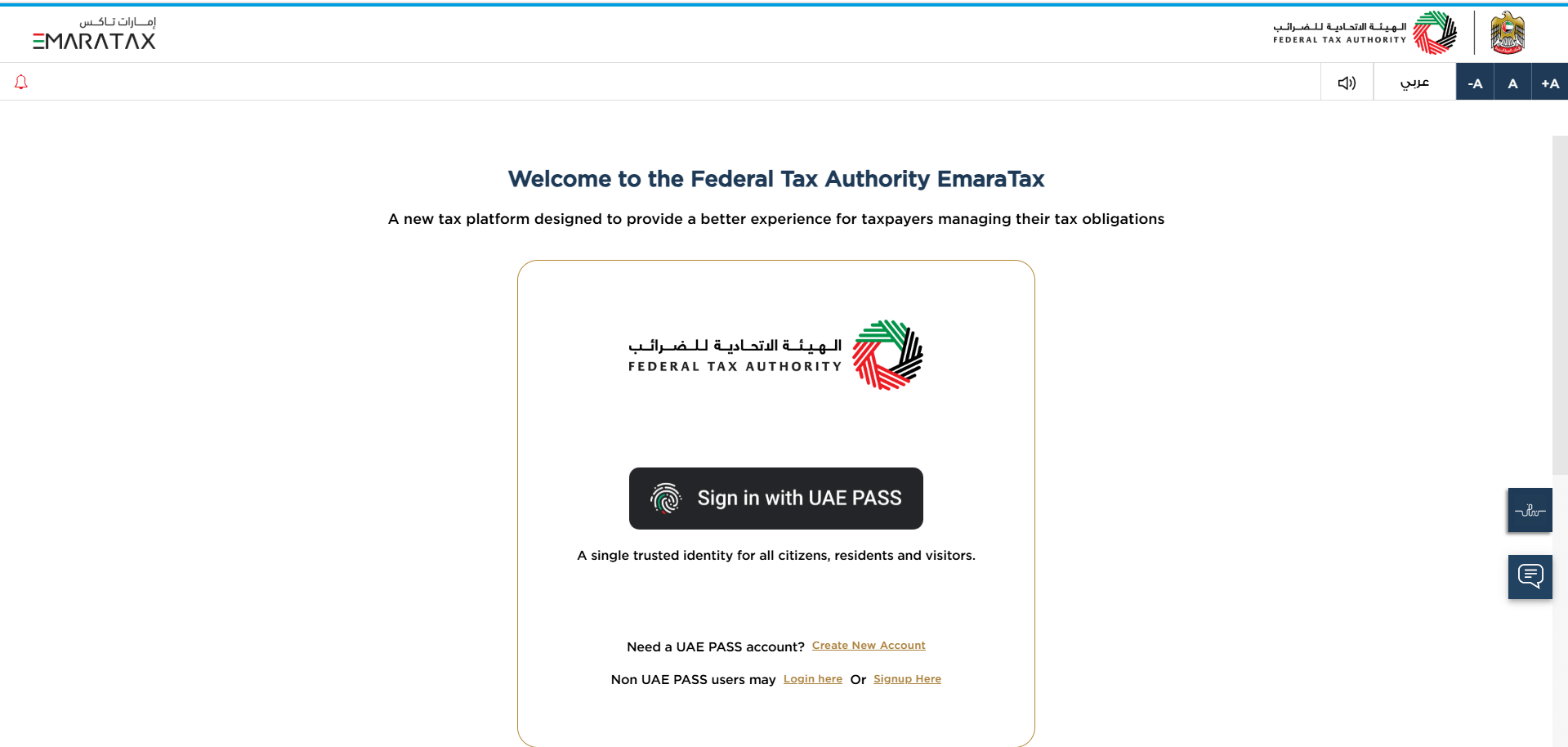
Many businesses face penalties and other difficulties when dealing with the UAE corporation tax. The FTA has clear rules, but overlooking details can delay approval or trigger fines. Below are the most frequent registration mistakes, their consequences, and tips on how to avoid them:
| Mistake | Impact | How to Avoid |
|---|---|---|
| Using the wrong legal entity type | Application rejection or significant delay | Always check the entity type on your trade license |
| Missing the registration deadline | Immediate AED 10,000 penalty | Monitor your UAE corporate tax deadlines closely based on your license issue date, and submit well before the corporate tax registration deadline |
| Uploading incomplete or unclear documents | Application may be put on hold or rejected, requiring resubmission | Prepare all required documents in advance and ensure scans are clear, complete, and valid |
| Failing to authorize the correct signatory | Application rejection and need for re-authorization | Confirm that the authorized signatory listed in your trade license or company records matches the one submitting the form |
| Mismatched financial year | AED 10,000 in penalties if the financial year information is considered outdated, and further penalties for the resulting late CT filings | Check the financial year in your submitted business formation documents (eg, MoA, AoA) to set CT filing timelines and update your CT information by submitting a ‘change of tax period’ application via EmaraTax |
You can change the financial year using a shareholder/board resolution approving the new financial year and updating the corporate documents, like your Memorandum of Association. Then, you can submit a ‘change of tax period’ application via EmaraTax, which should include the resolution, updated corporate documents, and the reason for changing the tax period.
The FTA approves or rejects such applications by evaluating whether the reason is genuine and not an attempt to manipulate tax deadlines. It also checks that the new tax period is not unusually short or long.
Companies must meet these ongoing corporate tax-related requirements to remain compliant:
Tip
Limit your engagement with subsidiaries and other related parties to minimize transfer pricing reporting obligations.
UAE’s corporate tax law can be intimidating to navigate for new businesses and established corporations alike. At skrooge.ai, we combine AI with experienced accountants to simplify the registration process and ongoing compliance.
Our services include:
Contact skrooge.ai today to ensure your business stays compliant with the UAE’s corporate tax law and avoids penalties.
Registering for corporate tax in the UAE is a legal requirement that keeps your business compliant and protected. The first hurdle you need to clear is the corporate tax registration deadline. Missing this deadline can trigger an AED 10,000 fine.
If you’d rather not deal with deadlines and forms, corporate tax consultants in Dubai, such as skrooge.ai, can handle the entire corporate tax registration UAE process so you can stay focused on growing your business.
Missing your CT registration deadline triggers the AED 10,000 penalty. However, the FTA has provisions for late CT registration penalty waivers.
If the first CT return or exempt-person annual declaration is submitted within 7 months of the end of the relevant tax period, the penalty is waived or refunded, depending on whether it was already paid. In such cases, there’s no need to file reconsideration requests. EmaraTax credits or removes the penalty in the background.
Businesses can apply for late CT registration penalty waivers, but approval is entirely discretionary. Strong documented reasons, such as serious illness, force majeure, system issues backed by evidence, are necessary for waiver approval. Even then, there is no guarantee that the FTA will waive the penalty.
Deadlines depend on your license issue date. Generally, businesses must register within 3 months from issuance. Missing deadlines may result in an AED 10,000 penalty.
In general, all the businesses, whether they are mainland companies, free zone entities, or foreign companies with PEs, must register, even if they qualify for 0% rate or relief. But there are some exceptions, like government entities and investment funds.
Yes, even loss-making or zero-revenue companies must register for CT as long as they are taxable persons. CT payable can be zero, but the registration and filing obligations remain.
Key documents required for corporate tax registration in the UAE include trade licenses, Emirates IDs, passport copies, business activity details, Memorandum of Association, and authorized signatory documents.
Registration timeline typically takes up to 20 business days via the EmaraTax portal. We have seen companies that missed the CT registration deadline because of the FTA approval wait time. So, if the deadline is close or has already passed, it’s better not to delay the application.
The FTA imposes an AED 10,000 fine for late registration. This may also affect your ability to file returns on time.
You can register independently via EmaraTax, but professional support helps avoid errors and delays.
Yes, all free zone entities must register, though some may benefit from 0% tax.
EmaraTax is FTA’s official online portal. You can access it through the FTA website.
The FTA reviews applications, issues TRNs if approved, and enables filing.
Registration itself is free. Skrooge offers registration assistance at AED 399.
The date of incorporation in your CT registration application should be consistent with the one in your Certificate of Incorporation (CoI). If you do not have a CoI, you should refer to the Memorandum of Association (MoA) or Articles of Association (AoA).
Thank you!
We've received your request and will get back to you shortly.
Loading...
Reach out yourself using the options below.