
Wage Protection System (WPS) in UAE: How does it work?
The Wage Protection System (WPS) is an electronic salary transfer system that ensures employees in…
The Wage Protection System (WPS) was introduced in response to multiple reports regarding delayed or missing salaries.
Through the WPS, the federal government allows organizations in the private sector to pay their employees’ wages via banks, exchange houses, and approved financial institutions.
WPS was first introduced in July, 2009 via Ministerial Decree No. 788 of 2009.
The Central Bank of the UAE oversees the WPS and governs compliance with the regulations set by the Ministry of Human Resources and Emiratisation (MOHRE).
In this manual, we walk you through registration for WPS, whether you’re a first time resident owner or currently thinking of expanding to the UAE market.
The Wage Protection System (WPS) is an electronic salary transfer system and regulatory requirement so employees receive their salaries on time.
As an electronic salary transfer system, WPS ensures that salaries are paid electronically through recognized banks, exchange houses, or financial institutions.
Employees in the private sector are typically required to receive their pay on the first day of the month that follows the payment period specified in the contract. Depending on what is decided upon throughout the recruiting process, employers may also establish a different payment plan. It is considered as late payment if the salary is not paid within 15 days of the due date.
Employers who disregard WPS regulation risk fines, termination of employment contracts, and more legal scrutiny.
WPS generally applies to private-sector establishments registered with MOHRE.
However, certain employees may be excluded from WPS monitoring, including:
Similarly, the following establishments are not required to use Wage Protection System:
A more recent Ministry resolution has extended WPS as mandatory for such categories of domestic workers:
Many Dubai free zones (e.g., DIFC, ADGM and others with independent regulators) operate outside MOHRE jurisdiction. Even if WPS is not mandatory, some free zones may encourage or allow WPS for standardization and audit purposes.
WPS reduces manual errors and administrative burdens associated with payroll processes.
Additionally, WPS enforces trust. Employers must have a corporate bank account with a financial institution recognized by the Central Bank of the UAE to use WPS.
By requiring paperwork and digitizing payroll, WPS protects vulnerable populations while assisting companies in keeping accurate financial records by standardizing salary payments.
Your company must be registered with MOHRE to start the WPS registration process.
Don’t forget to stay current and complete your compliance on a regular basis. Update salary disbursement periods, benefits, and new employee lists. Tag employee salaries for those who have worked for more than a month because this would instantly alter their eligibility.
All private sector companies registered with MOHRE are included under WPS.
You need to secure your employees’ bank account and other crucial information, usually handled by the manager or the company’s Human Resources team. This is typically done after hiring negotiations and once the employee joins the company.
Note that employee’s banking information must be accurate and ideally linked to respective banks that support WPS.
Open an official bank account (You can use these steps as a guide if it’s your first time).
Note
If your company is a UAE-licensed legal entity, banks may approve onboarding even if some shareholders are non-resident.
Requirements vary, and many banks prefer at least one UAE-resident authorized signatory depending on the setup.
You need to select a WPS agent, which is usually a UAE bank or financial institution that handles salary payments.
You can then sign an agreement with the participating bank or financial institution.
You can verify this by checking with MOHRE, Central Bank, or other official federal government portals. You can also just ask the bank directly for their accreditation.
The Salary Information File (SIF) must include details of employee wages, such as salaries, bonuses, and deductions.
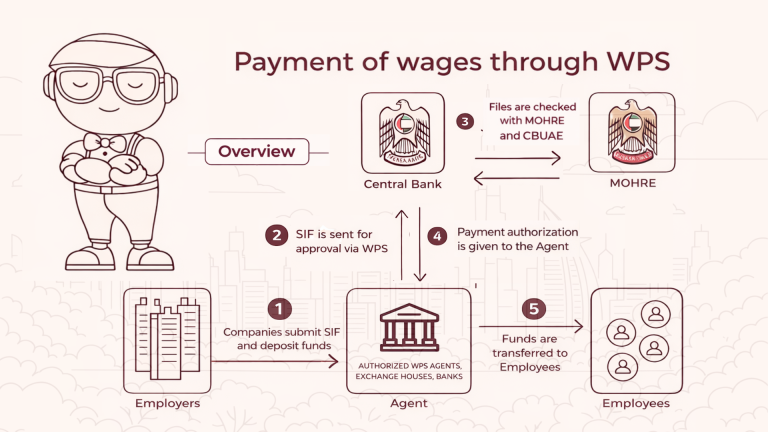
Once the SIF is submitted, your WPS agent will handle the payment processing and transfer wages to the employees’ accounts.
The WPS registration process usually takes a few working days if all necessary documents are submitted correctly.
The employer submits wage data through its contracted WPS payment agent.
The CBUAE secures the employer’s funds and dispatches wage information to the relevant agents, while system data supports regulatory monitoring of salary payments.
WPS registration is a mandatory UAE government initiative requiring employers to pay employee salaries via authorized banks, exchange houses, or financial institutions.
An establishment is generally considered compliant if:
MOHRE electronically monitors salary payment submitted. To facilitate compliance, employees may receive alerts for delays and flags for incomplete or inconsistent payroll docs.
Consequences for non compliance include downgrading of company classification under MOHRE’s categories. Full compliance and timely salary payments can benefit you with lowest government fees and faster processing of work permits.
Downgrading to the least compliant category may incur restrictions, increased inspections and risk of higher government fees by virtue of penalties and fines.
The WPS requires that all salary payments be made on time and in full according to the regulations outlined by MOHRE. Salaries must be paid within 15 days of the due date. WPS compliance requirements generally do not apply to new employees within 30 days of the wage due date.
After 15 days have passed, MOHRE may stop granting new work permits. For businesses employing more than fifty people, it is possible to schedule an inspection and report infractions to the appropriate authorities.
Roughly 45 days post due date, the case may be referred to a public prosecutor and legal action may be initiated. Repeated violations within six months can expect penalties and demotion of the company’s classification category under MOHRE.
Late salary payments beyond 17 days result in suspension of work permit issuance, while delays of 45–60 or more days may lead to fines and legal action.
Incorrect or incomplete information in the Salary Information File (SIF) may cause payment delays and fines.
Repeated WPS violations may lead to administrative fines, restrictions on work permits, and reclassification of the establishment, depending on the circumstances and enforcement action taken by MOHRE.
But beyond being held liable for penalties, companies face operational headaches such as:
If you want to learn more about the Wage Protection System, read about it in detail here.
skrooge.ai combines human expertise with complete automation to manage payroll. We help you with managing monthly payroll, calculating benefits, EOSB and reimbursements that tie perfectly into your books. All while securing your data and ensuring we avoid any penalties under the law.
Check out what our clients have to say and learn more here.
The Wage Protection System is an electronic system that enables companies to transfer salaries on time.
All private sector companies registered with the Ministry of Human Resources and Emiratisation (MOHRE) are included under WPS.
After the employer submits wage data through its contracted WPS agent, the CBUAE processes the payment flow and the system supports regulatory monitoring of salary transfers.
Registration in the WPS is mandatory for most private-sector companies in the UAE. All private sector companies registered with MOHRE are included under WPS and must comply with its regulations.
However, many Dubai free zones (e.g., DIFC, ADGM and others with independent regulators) operate outside MOHRE jurisdiction. Even if WPS is not mandatory, some free zones may encourage or allow WPS for standardization and audit purposes.
To register, you must have:
✓ Valid trade license and corporate registration documents
✓ MOHRE establishment details
✓ Authorized signatory and identification
✓ Company bank application forms and WPS agreement with bank or exchange houses
Once set up, employers must prepare and submit payroll through a “payment order” or the SIF. The Salary Information File (SIF) must include basic wages, allowances, and legally permissible deductions to ensure the net salary is correct.
Check first on their authorization as a WPS agent and look at how well they are integrated into your operations.
Ideally, pick one that’s nearest your office so it’s easier for employees to access (or alternatively, check if bank offers salary cards, wide ATM networks, or easier access for funds).
Banks are usually the common practice but exchange houses are sometimes cheaper and more common for businesses with unbanked or underbanked workers.
Yes, in principle employers can pay different groups through different banks, salary cards via exchange houses, or other routing system they would prefer.
However, while this improves flexibility for employees with different payout preferences, paying via multiple channels makes it more complex operationally.
Multiple institutions would mean multiple validation processes, more coordination and overall higher risk of mismatched data and rejected files.
It is best practice to centralize payroll in one platform.
Typically, you will receive feedback from banks or exchange houses. This must be corrected immediately after rejection to avoid issues.
After updating and correcting the data, you need to regenerate the SIF in a validated template, and have it resubmitted promptly for successful processing.
If at least 80% of the registered wages are paid, the employee may still be considered as having received their salary payments, provided deductions are legally documented.
If underpayment is not justified or documented, this triggers compliance risks for the employer. Employee may also file a wage related labour complaint if unresolved.
Rule of thumb is SIF must only include basic wage, allowances, and any deductions (including advance recoveries).
Bonuses are included in WPS if:
1. They are part of the agreed salary structure or regularly paid compensation.
2. They are recorded in payroll and reflected in the SIF.
They are not required if it is discretionary, one-off or “off-cycle” payments not part of the fixed wages.
Salary advances are NOT treated as wages. They are paid outside regular payroll cycle. It can only be reflected in SIF by virtue of being recovered later as deductions.
The deduction must be legally permitted, supported by proper payroll documents, and reflected accurately in the SIF.
Thank you!
We've received your request and will get back to you shortly.

Loading...