


Corporate Tax Registration in UAE: Full Guide 2025
In the UAE, businesses must register within 3 months for corporate tax to avoid the…
In the middle of every difficulty lies opportunity.
— Albert Einstein

If you’re doing business in the UAE, you probably already heard something about the importance of Corporate Tax registration and the hard-hitting fines for missing the deadline. The Federal Tax Authority (FTA) has made it official: every business, from small startups in Dubai to companies operating in free zones, needs to register. It’s not just another formality — missing it could get you a AED 10,000 fine, and that’s before we even talk about the headaches of being non-compliant.
So what exactly needs to be done, and when? That’s what this guide is here for. We’ll go through the essentials — who needs to register, the FTA deadlines, which documents you’ll need, and how the whole process works inside the EmaraTax portal.
The goal is simple: help you stay compliant without getting lost in bureaucracy. By the end, you’ll know exactly how to register for UAE corporate tax — and you can get back to running your business instead of worrying about penalties.
Back in 2022, the UAE introduced a new federal uae corporate tax law – registration is now required under Federal Decree-Law No. 47. This applies to both mainland companies and those operating in free zone businesses.
So, if your business earns more than AED 375,000 in taxable income during the corporate tax period, you’ll be taxed at 9%.
But there’s a catch – Small Business Relief: UAE-resident taxpayers with revenue not exceeding AED 3 million can elect a 0% corporate tax outcome for periods ending on or before 31 December 2026. This relief does not apply to Qualifying Free Zone Persons or large MNE groups.
In the UAE, the Federal Tax Authority (FTA) requires every taxable person to register for corporate tax — even if your business doesn’t expect to pay any tax or is fully exempt. The idea is simple: the FTA wants every business to be officially on the radar so that tax reporting and compliance run smoothly.
So, is corporate tax registration mandatory in UAE? Yes. Every business, even those with low or exempt income, must register for for corporate tax to stay compliant.
Exempt persons: Some entities do not need to register for corporate tax UAE, such as:
Now, here’s something a lot of people miss when dealing with UAE corporate tax law:
even if your company qualifies for a 0% tax rate – like a small business under the Small Business Relief scheme or a free zone setup – you still have to register if you do not fall under the exception.
The FTA wants every business on the books to keep things transparent and in line with the rules. Ignoring the corporate tax UAE registration last date could result in penalties.
The UAE corporate tax registration deadline depends on the date of your business license information issuance. Missing the deadline leads to an administrative penalty of AED 10,000.
The corporate tax UAE registration deadline depends on the date of your business license issuance.
| License Issue Date | Registration Deadline |
Before 1 March 2024 | By 31 May 2024 |
From 1 April 2024 | Within 3 months of license issue |
| Header 1 | Header 2 |
|---|---|
| Content 1 | Content 2 |
| Content 1 | Content 2 |
Failing to meet tax registration deadline UAE will also affect the ability to file returns on time, increasing compliance risks.
To complete the UAE corporate tax registration process, businesses must prepare specific paperwork. The documents required for corporate tax registration in UAE are as follows:
Tip: Collect all tax registration documents in advance to avoid delays. Keeping the documents required for corporate tax registration ready before the corporate tax registration UAE deadline ensures a smoother process.
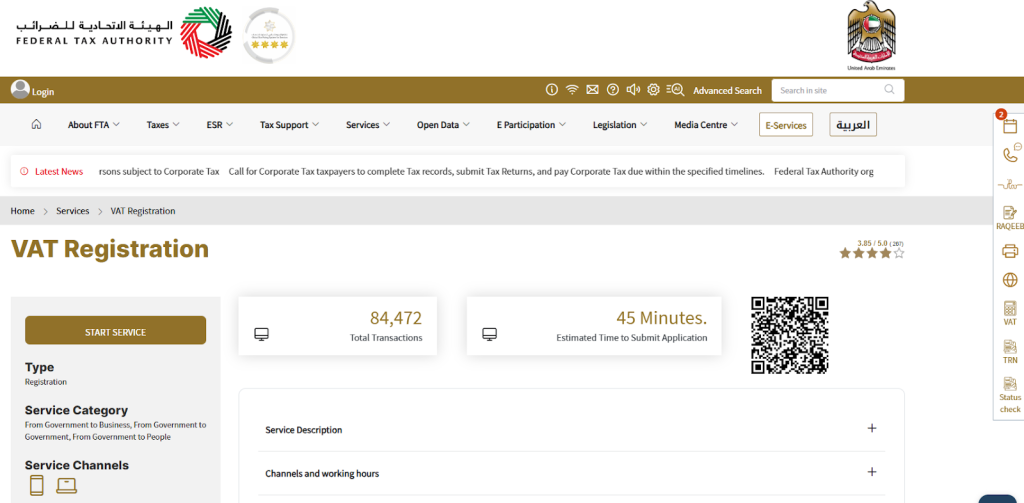
If you’re handling your setup in the UAE, chances are you’ll be doing it through EmaraTax – the official Federal Tax Authority platform. It’s the same system used for VAT and excise tax, and now it covers tax registration UAE too.
Below are the key steps you’ll likely need to complete to register for corporate tax in or UAE.
Visit the Federal Tax Authority website and access the EmaraTax portal.
Sign up using your company details, email address, and mobile number.
Assign an authorized signatory, who will be responsible for submitting tax-related forms.
After account activation, log in to your UAE corporate tax dashboard.
Choose the Corporate Tax option under services.
Add your company’s main details – trade license number, type of legal entity (like LLC or PJSC), and a brief overview of what your business does.
List owner details and the authorized signatory – the person legally allowed to sign and act on behalf of the company.
These include: trade license, Emirates ID, passport copies of owners/partners, and proof of business activities.
Make sure everything’s current and the scans are clear. Blurry images or expired documents are one of the most common reasons applications get kicked back, so it’s worth double-checking before you upload.
After verifying all information, submit the form.
You will receive a reference number to track your application status.
The EmaraTax dashboard allows you to monitor the progress of your application in real time.
If the FTA requires clarifications or additional documents, you will be notified directly through the portal.
Once approved, the FTA issues a Corporate Tax Registration Number (TRN).
This number confirms that your business is registered and must be used for all future filings and communications with the FTA.
The process usually takes 2–3 weeks. But small mistakes can slow corporate tax registration process down, so it’s worth double-checking before you hit submit. Many businesses choose to hire a tax advisor for smoother UAE corporate tax submissions.
Many businesses face penalties and other difficulties when dealing with UAE corporation tax. The FTA has clear rules, but overlooking details can delay approval or trigger fines. Below are the most frequent registration mistakes, their consequences, and tips how to avoid them:
Mistake | Consequences | How to Avoid |
|---|---|---|
Using the wrong legal entity type | Application rejection or significant delay in approval. | Always check your trade license to ensure the correct legal entity (e.g., LLC, sole establishment, or partnership) is selected before submission. |
Missing the registration deadline | Immediate AED 10,000 penalty and potential non-compliance with FTA regulations. | Monitor your UAE corporate tax deadlines closely based on your license issue date, and submit well before the corporate tax registration deadline UAE. |
Uploading incomplete or unclear documents | Application may be put on hold or rejected, requiring re-submission. | Prepare all required documents in advance and ensure scans are clear, complete, and valid. |
Failing to authorize the correct signatory | Rejection of the registration application and need for re-authorization. | Confirm that the authorized signatory listed in your trade license or company records matches the one submitting the form. |
Ignoring compliance updates from the FTA | Missed changes to requirements or filing obligations, leading to possible fines or non-compliance. | Regularly review FTA updates or work with a professional to ensure ongoing compliance with corporation tax laws. |
The takeaway: registration mistakes are avoidable with thorough preparation. Always verify details—the last date to register for corporate tax in UAE is strictly enforced, and fixing errors later is both costly and time-consuming.
Registration is just the first step. Companies must meet ongoing tax obligations to remain compliant:
Filing timelines are based on the relevant tax period, and obligations differ depending on the company’s financial year. Just as the corporate tax registration deadline 2023 set a strict precedent for timely registration, ongoing compliance deadlines are equally important.
Navigating UAE corporate tax law can be complex. At Skrooge, we combine AI with experienced accountants to simplify the process.
Our services include:
Contact Skrooge today to ensure your business stays compliant with the tax authority and avoids penalties.
Registering for corporate tax in the UAE isn’t optional – it’s a legal requirement that keeps your business compliant and protected. Whether you’re handling corporate tax in Dubai or anywhere across the UAE, meeting the UAE corporate tax registration last date is essential to avoid penalties and stay on track. If you’d rather not deal with deadlines and forms, Skrooge can handle the entire corporate tax registration UAE process for you – from paperwork to ongoing compliance – so you can stay focused on growing your business.
Let’s look at some of the most common questions our readers ask.
Deadlines depend on your license issue date. Generally, businesses must register within 3 months of issuance. Missing deadlines may result in an AED 10,000 penalty. The last date of corporate tax registration in UAE is strictly enforced, so make sure you know your own corporate tax registration last date.
If you’re wondering who should register for corporate tax in UAE – In general, all the businesses – mainland, free zone, and foreign with a PE – must register, even if they qualify for a 0% rate or relief. But there are some exceptions: government controlled entities and investment funds.
Key documents required for corporate tax registration in UAE include trade license, Emirates ID, passport copies, business activity details, and financial information. Preparing all corporate tax registration requirements in advance helps avoid delays.
Registration timeline typically takes up to 20 working days via the EmaraTax portal. For businesses in the UAE, the corporate tax registration process is handled online through the same system.
The FTA imposes an AED 10,000 fine for late registration. You must apply for the VAT registration within 30 days after your annual turnover hits AED 375,000 threshold. Missing the deadline for corporate tax registration or the last date for corporate tax registration may also affect the ability to file returns on time.
You can register independently via EmaraTax, but professional support helps avoid errors and delays.
Yes, all free zone entities must register, though some may benefit from 0% tax. Corporate tax registration for freezone company is mandatory, even if you ultimately qualify for tax relief.
EmaraTax is the official online portal of the FTA. You can access it through the FTA website.
The FTA reviews your application, issues a TRN if approved, and enables filing obligations.
Registration itself is free. Skrooge offers expert tax filing services starting at AED 499.
How satisfied are you with the Content Editor?
Terrible
Bad
Ok
Thank you!
We've received your request and will get back to you shortly.

Loading...
Reach out yourself using the options below.