Corporate Tax registration for only AED 89

Proper tax invoice format UAE

What is a tax invoice in the UAE?

A tax invoice is a document that VAT-registered businesses must issue for any taxable supply to recognize a revenue transaction. A tax invoice should be issued by the seller to the buyer within 14 days of the date of supply. The copy of the invoice must be stored for audit purposes:

  • for 5 years in general
  • for 15 years, in case of transactions related to real estate

In the UAE, companies most often exchange electronic invoices in PDF format. However, in 2026, e-invoicing is expected to be introduced in the UAE, which should help standardize the tax invoice format.

Why is it important to store properly formatted tax invoices?

These tax invoice records serve as the basis of the financial documentation for your company and ensure tax compliance with UAE VAT regulations:

  • When properly issued to your buyers, they help you avoid a 2,500 AED administrative fine for each case of an unissued or incorrectly formatted tax invoice
  • Once received from your suppliers, they serve as proof of the purchase transaction to claim input VAT

Even if your business is not VAT-registered yet, it’s important to store properly formatted tax invoices for the purchase transactions, because:

  • You can still use them after registering to claim input VAT. Purchases of services can be claimed within a 5-year period from the date of purchase, while goods can be claimed for their unused portion. For example, for capital assets, this would be the non-depreciated portion.
  • VAT-compliant tax invoices also ensure that your expenses will be deductible for corporate tax (CT) purposes as well. More on that point below

CT-compliant purchase invoices

Although CT regulation doesn’t strictly define the required invoice fields (unlike VAT), you must still keep adequate records to substantiate income/expenses and file correctly; the record-keeping period is 7 years after the end of the relevant Tax Period.

So, in our practice, we rigorously check that the following fields are listed on the invoices that our clients receive, so that their expenses are deductible for CT purposes:

FieldRequirement
Issuing company nameMust be valid and verifiable via FTA
Recipient nameMust match your registered business details
Invoice dateMust reflect the actual transaction date
Unique invoice numberEnables traceability and record tracking
Description of goods or servicesMust be specific and clear, not generic
Currency and amountUsed to calculate the taxable base

What if the purchase invoice doesn’t contain one of the fields above?

You might lose on two fronts:

  • The expense will not be recognized for CT deduction (9% of the purchase amount) because the transaction records are not sufficient
  • You will not be able to claim input VAT (5% of the purchase amount) because these fields are required for VAT compliance of the invoice as well. As you will see in the next section, VAT invoice standards in the UAE are stricter than those for CT and require more fields to be present in the invoice

So, overall, you could effectively overpay up to 14% of the purchase amount. At skrooge.ai, we ensure that on both fronts your invoices remain compliant, deductible, and penalty-free.

VAT invoice format: full tax invoice vs simplified invoice

There are two types of VAT invoice formats: full tax invoice and simplified tax invoice. Let’s take a closer look at them.

A full (standard) tax invoice is a detailed document that a seller issues to a buyer for a taxable supply to recognize a revenue transaction. You must issue a full tax invoice if at least one of the following FTA conditions is met:

  • The recipient is VAT-registered.
  • The amount of the supplies exceeds AED 10,000.

So, it is typically used for B2B transactions.

A simplified tax invoice is a streamlined version of a full (standard) tax invoice. It is often issued by retail companies involved in B2C transactions. For example, any receipt from a grocery store is a simplified tax invoice. You can use it in the following cases:

  • Transactions valued at AED 10,000 or less
  • Sales to customers who are not VAT-registered

It must be issued on the same day as the sale or service occurs. As you can probably guess from the names, the requirements for a full tax invoice are higher (more fields are required) compared to the simplified tax invoice.

Federal Tax Authority (FTA) requirements for a full (standard) tax invoice

  • The words “Tax Invoice” clearly displayed on the invoice
  • Issuing company (supplier) name with address and Tax Registration Number
  • Recipient company (customer) name with address and Tax Registration Number
  • Unique invoice number
  • The issue date
  • The date of supply, if different from the date of issuing the tax invoice
  • A description of the goods or services supplied
  • For each good or service: the unit price, the quantity or volume supplied, the rate of tax, and the amount payable in AED
  • The amount of any discount offered
  • The gross amount payable in AED
  • The VAT amount charged in AED
  • Exchange rate, if applicable

If you’re having trouble drafting a document, you can download our full tax invoice template (in the relevant section below). We also attach the tax invoice template for foreign currency (FX) transactions, which emphasizes the importance of displaying the exchange rate, gross amount, and tax amount in AED, in addition to the FX amounts.

FTA requirements for a simplified tax invoice

It shall contain all of the following particulars according to Federal Tax Authority Requirements:

  • The words “Tax Invoice” are clearly displayed on the invoice
  • The name, address, and TRN of the registrant making the supply
  • The issue date
  • A description of the goods or services supplied
  • The gross amount payable and the VAT amount charged in AED

Comparison Table: simplified tax invoice format vs full tax invoice

Let’s take a look at the differences between the different tax invoice formats:

FieldFull tax invoiceSimplified tax invoice
“Tax invoice” clearly displayedYesYes
Supplier name with address and TRNYesYes
Invoice dateYesYes
Description of goods and servicesYesYes
Gross amount payable & VAT amount (AED)YesYes
Recipient company (customer) name with address and TRNYes
Invoice numberYes
Supply dateYes
For each good or service: unit price, quantity, taxable amount, VAT rate and amount, amount payable in AEDYes
Exchange rate (if FX transaction)Yes

How to calculate VAT?

Here is a good example of how to calculate VAT.

For the supply of goods/services for AED 20,000 at a 5% VAT rate:

  • Net amount: AED 20,000
  • Discount applied (10% rate): AED 2,000
  • VAT amount (5% rate): AED 1,000 = 18,000 * 5%
  • Gross amount: AED 21,000.

An important nuance is that VAT is added after the discount is applied. However, we don’t anticipate any issues with these calculations, as all accounting software packages are designed to do it correctly.

Common mistakes and penalties

Non-compliance with FTA tax invoice requirements may result in large fines. Let’s break down the most common mistakes, what they can cost you, and how to avoid them.

Table with the most common FTA violations and penalties

ViolationPenaltyHow to avoid
Incorrectly issued or unissued tax invoiceAED 2,500 fine for each detected caseUse up-to-date templates when issuing invoices; Check FTA requirements regularly
Wrong VAT filing (due to incorrect purchase tax invoices leading to inadmissible VAT) – if mistake is uncovered during the FTA audit50% of the unpaid tax amount plus 4% penalty per monthCheck the compliance of the invoices issued by your vendors
Wrong VAT filing – if mistake is reported by the company5% of the unpaid tax (increases to 40% if filed in 4 years) amount plus 4% penalty per monthCheck the compliance of the invoices issued by your vendors

Source: Administrative Penalties for Violation of Tax Laws in the UAE

Who is Skrooge, and how can he help you with tax invoice compliance?

Skrooge is an AI accountant backed by a team of professional financiers and accountants. Basically, he’s an AI CFO who sorts, reconciles, files, and reminds without mistakes or breaks.

The advantage of using Skrooge to ensure tax invoice compliance is that he can handle any volume of invoices for any number of clients at a speed not achievable by human accountants. That’s why our team is focused on more strategic tasks, such as designing custom charts of accounts or providing complex tax advisory services for our clients.

Useful templates

Our team of professional accountants has prepared user-friendly tax invoice templates that meet the Federal Tax Authority requirements.

Offering layout can be tailored with your:

  • Company logo
  • Business information
  • Customer details
  • Itemized lists
  • Tax calculations

What else can skrooge.ai help you with?

skrooge.ai delivers end-to-end accounting & tax services across all UAE jurisdictions, combining expert accountants with AI-powered software, and can help you with:

  • Bookkeeping & Accounting
    No more missing invoices, just precise, audit-ready numbers
  • Financial Reports & Dashboards
    Your P&L, Cash Flow, and Balance Sheet, always clear, always up to date
  • Corporate Tax & VAT Filing
    Deadlines handled, fines avoided, ensure compliance on autopilot
  • Tax Advisory
    Practical, business-first guidance that cuts your bill and your stress

FAQ: Tax Invoice Format UAE

What are the mandatory details for the compliant VAT invoice format according to the Federal Tax Authority FTA?

The essential details for the compliant VAT invoice format are the words “Tax invoice” clearly displayed; supplier name with address and TRN; customer name with address and TRN; invoice number; the invoice date; the date of supply; the description of goods/services provided; for each good or service: unit price, quantity, VAT rate, VAT amount, the amount payable in AED; discounts (if any); gross amount payable in AED; total VAT amount in AED; exchange rate if applicable.

What penalties apply for an incorrect tax invoice format UAE?

Penalties begin at AED 2,500 for missing details on issued tax invoices. There is also a variable penalty (5% or 50%, depending on who discovers the mistake—you or FTA) applied to the unpaid VAT amount due to non-compliant purchase tax invoices. For each month that this amount remains unpaid, an additional 4% penalty will be added.

Can I use tax invoice templates for my UAE business?

Yes, skrooge.ai offers a free template that meets all the Federal Tax Authority requirements.

How to handle tax invoices in foreign currencies?

When issuing tax invoices in a currency other than AED, you are required to convert the taxable amount and the VAT amount into dirhams using the official exchange rate applied as published by the UAE Central Bank on the exact date of supply. The exchange rate must be clearly displayed on the invoice.

What is the difference between VAT Return filing and Tax Invoice?

VAT Return is the periodic summary you file with the FTA showing total VAT due or refundable for the period, whereas a tax invoice serves as the legal proof for each taxable supply and the VAT charged.

For how long must invoices be stored? What happens if a company does not keep Tax Invoices?

In the UAE, tax invoices must be stored for a minimum of 5 years and a maximum of 15 years for real estate records. If a company fails to keep its tax invoices, the Federal Tax Authority (FTA) may impose administrative penalties and disallow input VAT recovery, which can increase the business’s overall tax liability.

How to calculate VAT?

To calculate VAT in the UAE, multiply the taxable amount (the value of goods or services) by the applicable VAT rate, currently 5%. For example, if the taxable value is AED 1,000, VAT = 1,000 × 5% = AED 50. The total invoice amount payable would then be AED 1,050.

Can I issue a handwritten tax invoice in the UAE?

Yes, handwritten tax invoices are legally allowed in the UAE as long as they contain all the mandatory details required by the FTA such as TRN, invoice date, description of goods/services, VAT amount, and total payable. However, most businesses use electronic invoicing systems because they reduce errors and make compliance easier.

This material is for informational purposes only and does not constitute legal or tax advice.
VAT Registration Requirements & Process: Beginner-Friendly Guide 

Hey there!

We know that VAT registration might be a real headache, so we’ve prepared this guide to help you navigate the intricacies of the process. In this Article, we’ll explain what VAT is, the registration requirements, including the list of documents needed, types of registration, the step-by-step process, and common mistakes to avoid. If, after reading it, you realize that you need our help, don’t hesitate — VAT registration services are included in our core scope. Let’s go!

What is a Value Added Tax?

Value Added Tax is a general sales tax applied to most goods and services in the UAE at each stage of the supply chain, with certain exemptions and zero-rated categories. It was introduced in the UAE on 1st January 2018 at a standard rate of 5% with the Federal Tax Authority (FTA) being responsible for the regulation and collection of VAT in the UAE. Businesses charge VAT on their sales (output tax) and can usually reclaim VAT paid on eligible business purchases (input tax).

Your obligation to register is linked to annual turnover — the value of your taxable supplies and imports over the past 12 months. Once you cross the relevant threshold, you must register, obtain a tax number, and start charging, recording, and filing VAT.

An important nuance to note is that if you paid input VAT on your purchase while unregistered, you can still recover it after registering. Purchases of services can be claimed within a 5-year period from the purchase date, while goods can be claimed for their unused portion – for example, for capital assets, this would be the non-depreciated portion.

VAT registration requirements

Mandatory vs Voluntary

There are two types of VAT registrations: mandatory and voluntary. Let’s find out the difference between them.

Mandatory registration is required for your company if annual turnover exceeds AED 375,000 or is expected to surpass this level within the next 30 days, whichever occurs first. You can predict threshold surpasses based on signed contracts, scheduled deliveries, or pro forma invoices.

If you do not meet the mandatory threshold, you can opt for voluntary registration — but only in case your annual turnover exceeds AED 187,500 over the past 12 months, or is expected to do so in the next 30 days.

There is a benefit to registering for VAT voluntarily, which is the ability to claim input VAT early. Additionally, in the case of imports, this allows for the use of the reverse charge mechanism (RCM), which is cash-neutral, instead of paying cash VAT at the border.

If your company’s turnover is below AED 187,500, you do not need to register for VAT yet.

How to calculate your annual turnover?

To check whether your business has reached the VAT registration threshold, you need to calculate your annual turnover. In the UAE, turnover includes all taxable supplies and imports (taxable expenses) made during the past 12 months. When calculating it, follow the rule of the earliest event — your turnover is recognized based on whichever happens first:

  • The invoice is issued
  • The payment is received
  • The goods or services are delivered

For example: completed the service on March 5, issued an invoice on March 10, and received payment on March 15. For VAT purposes, the turnover is recognized on March 5, because that’s the earliest event.

This approach ensures that your VAT reporting reflects the actual timing of transactions, helping you stay compliant with Federal Tax Authority (FTA) requirements.

One important thing to mention is that you’ve probably noticed that in turnover, we’ve included imports, which might look odd. However, according to the regulation, if a company imports goods worth more than AED 375,000, it must register for VAT. However, as of the article’s publication date, we note that FTA disallows inclusion of imports (or other taxable expenses) when calculating turnover, relying solely on taxable supplies.

When do I have to apply for VAT registration, and how long would it take?

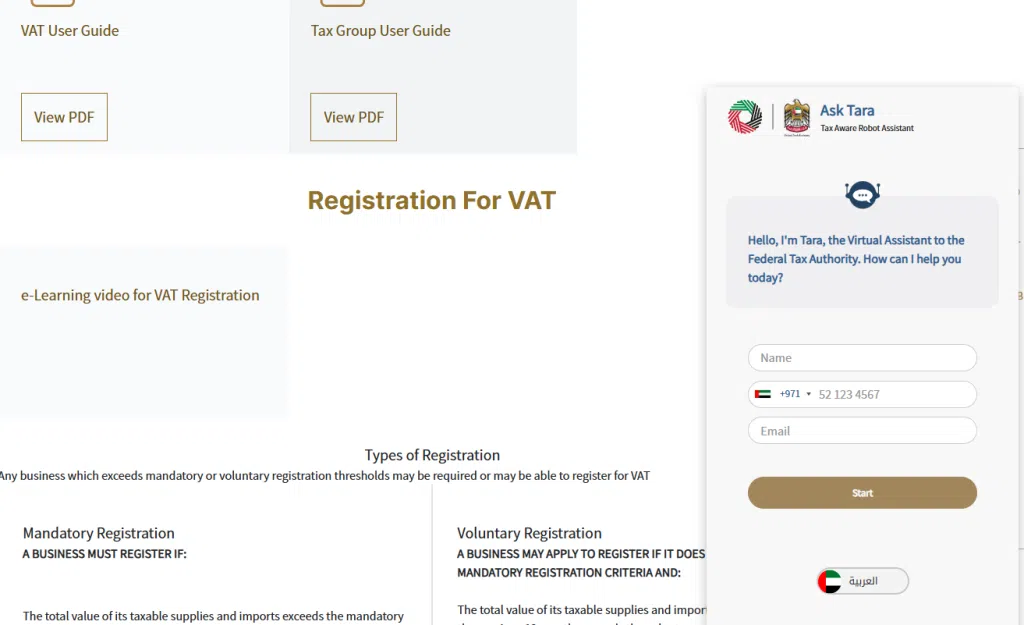
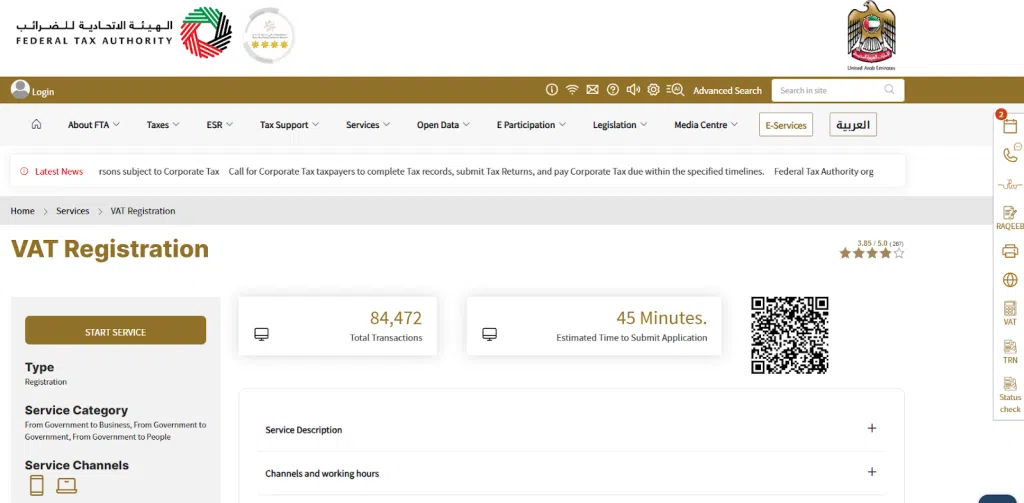
The VAT registration requirements are very clear. According to UAE tax laws, you must send in your application no later than 30 days after you become legally required to do so. In theory, it takes approximately 60-90 minutes to complete the online application, and the FTA processes your submission within 20 working days. However, in reality, it may take significantly longer due to incomplete documentation, missing data, and, consequently, queries from the Federal Tax Authority.

List of documents required for VAT registration in UAE

To obtain approval from the Federal Tax Authority quickly, you must carefully prepare the documents for VAT registration. This is very important because, in our experience, incorrect or incomplete paperwork is one of the biggest reasons for delays or rejections.

Required documents for VAT registration application (filled online on the FTA website)

Here is a checklist of the core documents required for VAT registration:

  • A valid trade license, along with branch licenses (if any)
  • Official declaration letter stating the total taxable supplies and monthly sales from the date of establishment until the date of application, stamped and signed by the authorized signatory
  • At least 3 sales tax invoices signed and stamped
  • Documents confirming expected revenue (optional)
  • Contact information, such as e-mail, mobile number, and office address (if any)

Additional documents for VAT registration

Here is an extra checklist of supplemental documents, based on business classification:

ClassificationDocuments Needed
For All Legal Entities● Certificate of Incorporation
Memorandum of Association / Articles of Association/Partnership Agreement
Emirates IDs for all Owners and Authorized Signatories
Passport copies for all Owners and Authorized Signatories
Power of attorney document for the Authorized Signatory, required if the Authorized Signatory is not mentioned in the Memorandum of Association.
Bank letter detailing the business’s bank account information (optional)
For Government EntitiesCopy of the Establishing Decree
For IndividualsEmirates ID and passport copy
Customs information (if available)
Bank letter
For Clubs/Charities/AssociationsRegistration documents and supporting evidence

Before submitting, ensure each scanned document (PDF or DOC) is under 15 MB and has clear text.

Source: FTA VAT registration requirements

Step-by-step guide: how to register for VAT?

Here is a step-by-step guide to help you register for VAT on the EmaraTax portal:

  • Create an EmaraTax Account
    Go to the FTA website and create an account. You can use UAE Pass to log in. 
  • Create a Taxable Person Profile
    After logging in, you must create a new “Taxable Person” profile. This is done by entering the mandatory details for your business entity.
  • Initiate Online VAT Registration
    To begin the formal VAT registration process, click the “Registration” button on the VAT tab in your Taxable Person dashboard.
  • Complete the Multi-Section Application
    Fill out all mandatory fields in each sequential section of the VAT registration form, starting with Entity Details and Identification Details. Then, you’ll be asked to supply Eligibility Details, Contact Details, Business Relationships, Bank Details (bank account details are optional but recommended), Additional Details, and Authorized Signatory information.
  • Review, Declare, and Submit
    Double-check the data you supplied in the final section of the VAT registration. Then, click “Submit” to send the paperwork for consideration. Save your application reference number.
  • Await Decision
    Keep an eye on your dashboard regularly – the FTA can request further information before the final decision regarding your VAT certificate. Based on our past experience, the average timeframe is 2-3 working weeks.
  • Get your VAT Certificate and Tax Registration Number (TRN)
    A TRN is required to file VAT returns and ensure legal compliance with FTA.

Registration assistance

If you need visual guidance to figure out how to register for VAT, you can refer to the helpful e-learning video provided by FTA. Also, all questions regarding the VAT in the UAE (how to pay VAT, how to file VAT returns, how to claim input tax credits, etc.) can be addressed to Tara, FTA’s AI assistant.

Common mistakes to avoid during UAE VAT registration

Here is a table with frequent VAT registration mistakes, their consequences, and tips to prevent them:

Common mistakeConsequencesHow to avoid
Incomplete paperworkRejection or application cannot proceedAlways check the FTA VAT Registration checklist before applying
Incorrect file formats or oversize filesUploads rejected; application cannot proceedSubmit PDF or DOC only;  Use online tools for compressing files if needed  
Data inconsistencyQueries from FTA or application rejectionUse documents with up-to-date information; Double-check the application before submission
Missing the 30-days registration deadlinePenalty of AED 10,000Track your rolling 12-month turnover against the mandatory registration threshold of AED 375,000 weekly; Set up calendar reminders before the deadline

skrooge.ai: Who are we, and how can we help you?

We are a next-generation accounting company — run by finance professionals and Skrooge, the clever AI CFO. Our team delivers precision, insight, and strategic guidance while AI automates the processes to make them scalable, consistent, quick and cost-effective. Our mission is straightforward: we save your budget, save your time, and handle your finances in a clear, convenient, and tax-compliant manner.

How can we help you with VAT registration and further compliance?

Applying for VAT registration can be overwhelming, as it involves tracking taxable supplies and imports, collecting documents, completing forms, and managing deadlines alongside business growth. That’s where skrooge.ai comes in. With us, the process will be smooth because we’ll track deadlines and ensure all documents are prepared and consistent. After the registration part, we will, of course, cover the regular quarterly VAT filing, which is a separate story.

  • No more rejected applications. We handle your registration process end-to-end.
  • No more missed thresholds. We constantly monitor your rolling 12-month turnover and inform you when it’s time to register for VAT.
  • No more skipped deadlines. Automated reminders help you stay on schedule, preventing penalties.
  • No more worries about future tax compliance. We cover your accounting — managing your periodic VAT returns and ongoing bookkeeping to ensure your VAT is accurate and on time.

This material is for informational purposes only and does not constitute legal or tax advice.
FAQ

Which documents are required for VAT registration in UAE?

Essential documents include the certificate of incorporation, active company trade license, MoA/AoA, and passports/EIDs of the owners and authorized signatories. Additional documents and financial records may be required based on your business type/activities.

How long does VAT registration take in UAE?

In theory, VAT registration UAE takes around 60-90 minutes to finish the online application, and the FTA takes up to 20 working days to process your submission. However, the process could take much longer due to missing documents and application errors. That’s why we recommend contacting professionals for tax registration.

Is VAT registration mandatory for all businesses in UAE?

It is mandatory only in case your taxable supplies and imports exceed the mandatory registration threshold of AED 375,000 in the past 12 months or are expected to do so in the next 30 days. For businesses below this level, but with an annual turnover exceeding the voluntary registration threshold of AED 187,500, registration in the UAE is elective.

What happens after VAT registration in the UAE?

Once your business receives its VAT Registration Number, you officially become a VAT-registered business and must start charging VAT on taxable supplies (see the article body for details on what this means). From this point, you can also claim input tax credits on your taxable expenses — meaning the VAT you pay on business purchases can be deducted from the VAT you collect from customers.

Can I register for VAT online in UAE?

Yes, you can register for VAT online. The entire process of VAT registration in the UAE is conducted online via the FTA portal. To begin, sign up for an EmaraTax account. Then, complete the application and attach any necessary digital documents for registration in the UAE. If you have any questions on how to register for VAT — book a call with us.

What is the difference between mandatory and voluntary VAT registration?

Mandatory registration is required by law when your annual turnover exceeds AED 375,000. Voluntary registration is an option for businesses exceeding the voluntary registration threshold of AED 187,500.

What happens if I don’t register for VAT when required?

Failing to register for VAT if you meet mandatory registration criteria before the due date can result in a penalty of AED 10,000.

Do I need an Emirates ID for VAT registration?

Usually, yes, if the authorized signatory or the owner is a UAE resident. If no one on the application is a UAE resident, you can proceed with passport copies instead.

Can skrooge.ai help with the VAT registration process?

Absolutely. skrooge.ai‘s team of experts, with multiple years of experience and backed by software/AI, handles the entire process. Whether you need VAT registration in Dubai, voluntary registration, assistance with financial documents, consultation on VAT laws, or any other related service, you can expect accuracy, speed, and full compliance.

What is a Tax Registration Number (TRN) and how to get it?

A TRN is a unique tax registration number issued by the FTA upon successful VAT registration for a new company. You get it by completing the online application on the EmaraTax portal, after which it will appear in your dashboard.

Is VAT an indirect tax?

Yes, Value Added Tax is an indirect tax. It is levied on the sale of goods and services, so it’s the end consumers who pay VAT. Businesses, on the other hand, charge VAT and remit it to the government on behalf of the tax authority.

Are there any fees for VAT registration in UAE?

No, the Federal Tax Authority does not charge any fee for VAT registration services, regardless of whether it’s a tax group, a legal person, or a sole establishment.

UAE Corporate Tax Filing 30 September 2025 Deadline Guide

1. Why September 30, 2025 Is Your UAE Corporate Tax D-Day

Many business owners still assume the UAE is tax-free. However, reality speaks for itself. Since 2017, the UAE has introduced excise tax, 5% VAT (effective from January 2018), and Federal Corporate Tax starting with financial years after June 2023. In practicality, the majority of mainland and free-zone companies are required to maintain accurate records for a period of seven years and submit their initial corporate tax return by 30 September 2025.

We hear so much confusion among business owners when we highlight how important it is for them to pay attention to their books right now. Quick summary:

  • First filing season ever
    30 September 2025 marks the nine-month deadline for calendar-year businesses (FY ending 31 December 2024) to file and pay CT
  • Cash flow impact
    The entire CT bill is due the same day you file without any instalments.
  • Automatic fines start immediately
    The Federal Tax Authority (FTA) levies AED 500 per month for the first 12 months for those who miss deadline, rising to AED 1,000 thereafter, plus 14 % annual interest on any unpaid tax.
  • Signal to banks & investors
    Timely compliance shows financial discipline which is critical when you’re raising or renewing credit lines.

In short…

30 September 2025 is a big day for UAE business owners; we prepared key information you need to know to avoid unpleasant surprises.

2. Who Must File a UAE Corporate Tax Return?

1. Two groups most SMEs fall into

Most startups and SMEs fall into one of these two buckets – so, if you’re here, a return is mandatory:

  • Mainland or Free-Zone Companies (legal person type – LLC, PSC, branch, etc.) regardless of their revenue threshold.
    • CT applies on worldwide income.
    • Rate: 0 % up to taxable profit of AED 375,000, 9 % above that.
  • Sole Establishments (natural person type – solopreneurs / freelancers / e-commerce sellers, etc.) operating under a license or permit having to register and file once annual turnover reaches AED 1 m (around AED 83,000 per month).

2. Helpful reliefs (but you still must file)

  • Small-Business Relief: you could elect 0 % CT when revenue ≤ AED 3 m for each period during 2024-2026. However, if you pick SBR, note that you can’t carry loss forward to decrease future tax bills, so use it only if business is profitable. If a company exceeds AED 3 m in revenue in any tax period, it cannot claim Small Business Relief for that period or any future periods.
  • Qualifying Free-Zone Person (QFZP): you keep 0% rate on qualifying income and pay 9% on everything else. You should check the “QFZP” box in every return and meet the substance rules (staff, office, real expenses).

3. Special cases for which you would need tailored advice:

  • Non-resident companies with a UAE permanent establishment or UAE-sourced income
  • Tax-exempt entities such as government bodies, pension / investment funds, etc. 
  • Large multinationals (≥ €750 m global revenue)

To sum up, there is a filing requirement for all UAE entities apart from Sole Establishments. If you need any help – talk to us or any other high-quality tax advisor.

3. Key Dates, Deadlines & FTA Penalties

Under the UAE Corporate Tax Law every Taxable Person must both file its return and pay any tax within 9 months of the end of its Tax Period.

Your FYI ends on:CT return + payment due by:
31 December 202430 September 2025
31 March 202531 December 2025
30 June 202531 March 2026

How to confirm your Financial Year (FY):

If it’s a Legal Person:

  • Refer to the MOA or select the FY through a Board resolution. The FY typically follows a 12-month cycle for financial statements; many SMEs opt for 1 January to 31 December.
  • Check the EmaraTax portal or CT registration certificate. When you open the CT return, the “Tax Period” is pre-filled in your account based on your input at CT registration — verify it before you file.
  • If MoA or BoD resolution are not aligned to the EmaraTax records with respect to FY, we highly recommend you amend them to be aligned.
  • If you need a different FY, you can apply with the FTA, but the first new period can’t be shorter than 6 months or longer than 18 months. Example: subsidiary incorporated 1 February 2024 but parent FYE is 31 March. You may request a 15-month first period (1 January 2024 → 31 March 2025); thereafter you follow an annual 1 April – 31 March cycle.

If it’s a Natural Person: always use the calendar year as the basis for FY.

So, who really has the 30 Sep 2025 deadline?

Most SMEs registered on or before 30 June 2024 never touched their FY settings, so their first tax period ended 31 December 2024 — making 30 September 2025 filing day.

Incorporated after 1 July 2024? Your first CT period probably ends 31 December 2025, so your deadline shifts to 30 September 2026 — but always confirm in EmaraTax portal or from the CT registration certificate.

Penalties for being late:

MissWhat it costs
Late CT registrationAED 10,000 one-off
Late CT return filingAED 500/month (first 12 m) → AED 1,000/month after
Late CT payment14 % p.a. interest on unpaid tax (calculated monthly)

Long story short, if your license predates July 2024, assume you owe a return (and payment) on 30 September 2025 unless you’ve formally changed the FY. Missing that date hurts far more than the paperwork headache.

4. Step-by-Step UAE Corporate Tax Filing Checklist

  • Confirm CT Registration (TRN)
    Log in to EmaraTax => “Corporate Tax” tile => make sure a CT Registration Number (TRN) appears.

    If you could not find TRN, register ASAP – it takes some time, but helps to avoid the AED 10,000 late-registration fine. If you already missed the deadline for registration, you could try to apply for penalty waiver, but it should be approved by FTA.
  • Close FY2024 Books & Reconcile VAT vs CT
    Record every transaction on an accrual basis using IFRS (or IFRS for SMEs).

    Always check for variances between VAT and Corporate Tax revenues to avoid FTA automatic flagging.
  • Prepare Financial Statements & Audit if Required
    Most SMEs can file unaudited management accounts.

    Mandatory audit is required only if 2024 revenue is more than AED 50m or you’re claiming Qualifying Free-Zone Person status. Audit is also often required by the FZs, being a pre-requisite for the trade license renewal.
  • Compute Taxable Income
    Start with accounting profit

    Remove exempt income (dividends, qualifying capital gains).
     
    Add back non-deductibles (fines, entertainment, etc.)
  • Choose Small-Business Relief if eligible
    If your revenue is ≤ AED 3 m, you could tick the SBR box to pay 0 % CT. But here is the important thing to remember – losses made in an SBR year cannot be carried forward, they disappear. So don’t use the SBR option unless your business is profitable and you understand pros / cons of your choice.
  • Lock In Your Optional Elections
    When filing your UAE Corporate Tax return, remember to tick any optional elections beyond Small-Business Relief – such as choosing to tax realized vs. unrealized FX gains, revaluation gains, or other fair-value movements. So your chosen treatment is locked in for the year and aligns with your financial statements.
  • Verify Substance If Electing QFZP
    Maintain real office space, adequate staff and qualifying income. In general, a more complicated topic we are going to elaborate on in a separate article. 
  • Handle Transfer Pricing
    When you sell to / buy from your own sister company, shareholder, or family business (called related party transactions), you need to use a price you’d accept from a stranger (“arm’s-length”).

    Select the one-page Transfer Pricing disclosure in the CT return.

    Master/Local files are required only if 2024 revenue is at least AED 200 m or you belong to a billion-dollar group.
  • Collect Foreign-Tax Credit Evidence 
    Such as receipts and returns to prove that you have already paid tax abroad
  • Be Prepared To Pay
    The full CT bill is due the same day you file—30 September 2025 for most SMEs
  • Make Sure You Archive Everything For 7 Years
    Keep ledgers, source documents (invoices, bills, receipts), contracts and audit reports ready for an FTA review

5. 7 Costly Corporate-Tax Mistakes (and How to Avoid Them)

MistakeWhat it costs / why it hurtsQuick fix
1. Skipping CT registrationFlat AED 10,000 fine the moment the FTA notices.Register on EmaraTax within 3 months from the date of incorporation.
2. Filing lateAED 500 / month (first 12 m) => AED 1,000 / month after.Calendar-block your 9-month deadline and file early.
3. Paying late14% per-year interest on unpaid tax, ticking daily.Make sure funds are available before filing—the payment is due on the same day.
4. Ticking “Small-Business Relief” without thinkingYou pay 0%, but any loss from that year disappears—you can’t use it later.Elect SBR only if your business is profitable or you don’t really care about losing tax-loss carry-forwards.
5. Assuming all Free-Zone income is 0 %The 0% applies only to “qualifying” income and if you have real substance; lose it for up to 5 years if you flunk the test.Keep staff, office, and books in the zone; split qualifying vs non-qualifying sales.
6. VAT vs CT revenue don’t matchFTA cross-checks portals—mismatches trigger audits.Reconcile VAT returns to your CT ledger before filing.
7. Forgetting the one-page Transfer-Pricing disclosurePenalties + follow-up queries if related-party deals aren’t reported.List owners, sister firms, and any inter-company invoices in the TP section of the return.

6. Why Good Books = Smooth Corporate Tax Returns?

Getting the TRN number after CT registration is just the beginning. A lot of business owners think that filing CT is literally about just filling in your Emaratax cabinet. But it is not, as in fact filing is the very last step of the complex day-to-day work of your accountant throughout the year.

A skilled accountant tags every transaction at 0%, 50%, 100% deductible for CT the moment it lands. When transactions are tagged properly throughout the year, filing is simply adding numbers up. Without that, you’re left chasing old receipts and explanations just weeks before the deadline. So, what you get as the business owner:

  • No last-minute scramble.
    You are in position of reviewer rather than builder of books nervously trying to recall what had happened with one or another transaction a year ago.
  • Visibility on reliefs.
    Real-time labelling of transactions shows you whether you are still eligible for SBR or not.
  • Bullet-proof audit trail.
    Each tag links back to source docs – invoices, contracts, bank feeds – meeting the FTA’s seven-year record-keeping rule.

We know for sure that a lot of accounting & bookkeeping firms provide quite “relaxed” standards towards financial hygiene. Below is the list of some obvious red flags from weak bookkeeping:

  • VAT sales don’t equal CT sales
  • Entertainment expenses are claimed at >50% cap
  • Untagged related party transactions
  • Claiming 0% QFZP without providing enough substance
  • Large year-end “other expense” bucket, which looks like profit shifting

7. How skrooge.ai Makes UAE Corporate-Tax Filing Effortless?

We feel the pain of business owners who say that “dealing with books & EmaraTax portal is not what inspires me a lot” and are excited about helping you to gain control over the finance part of your business at a reasonable price and in a convenient way. 

At skrooge.ai we combine smart automation with experienced finance professionals, so your UAE corporate-tax return is filed on time, error-free, and penalty-proof.

  • AI-powered bookkeeping.
    We feed your transaction data into smart algorithms that clean up mistakes, run UAE CT compliance checks, apply CT treatments (0%, 50%, 100) and prepare the filing form.
  • Convenient tracker of expiry dates & deadlines.
    We built an interface that clearly flags if any of your documents are close to expiry or you are missing an important deadline.
  • Personalized tax advice.
    Experienced UAE tax accountants review your figures and business model, then map out the optimal decision (Small Business Relief, the 0 % QFZP rate, or other allowances).
  • Human expertise on call.
    A team of UAE tax pros reviews edge cases, answers queries, and signs off on your final tax return.

skrooge.ai offers a complimentary 15-minute CT health check for individuals preparing their first filing. Drop an email to hello@skrooge.ai

8. Conclusion & Next Steps

The UAE’s initial Corporate Tax season has begun, with 30 September 2025 serving as the deadline for most startups and SMEs. So, our advice: fix your deadline in the calendar, prepare early, and keep your books clean. That way filing day is just another task, not a crisis.

If managing spreadsheets is overwhelming, let skrooge.ai handle it and keep you safe from penalties.

Ready to file stress-free? Book your free 15-minute CT health check with skrooge.ai today and get back to building your business.

9. Corporate Income Tax FAQs

If my taxable profit is less than AED 375,000, am I still required to file?

Yes. The rate is 0%, but the return is mandatory unless you are formally exempt.

Do I need to file if I had zero transactions in 2024?

Yes. Unless liquidated or exempt, a dormant company must file a nil return.

I am a Free Zone company, so my Corporate Tax is automatically 0%?

Only if you meet all substance tests to prove that your free zone entity is a QFZP; fail once and you pay 9 % for the next five years.

Do I need audited financial statements?

You require it when: 
Your 2024 revenue is > AED 50m 
You claim QFZP status.
Your Free Zone regulator requires you to do so (we are seeing a growing amount of FZs having such requirements). If you are not sure – call regulator directly (or us, we could help to sort out).
You operate in hotel industry. Hotels in UAE are required to file audited FS each year
You operate a mainland company. You don’t need to submit audited FS anywhere, but you should have it in place in case the regulator requests it.

Can I pay Corporate Tax in instalments?

Payment is due in full on the filing date, but instalments can be made before the deadline. After the deadline, instalment payments are not available, and late-payment interest will begin to accrue immediately.

Does choosing Small-Business Relief let me skip filing?

No. You still file every year, and any loss made under SBR can’t be carried forward. 

Can I change my financial year?

Approval from the FTA is required. The first period may be up to 18 months, while subsequent periods can range from 6 to 12 months. And applications should be submitted within six months of the previous year-end.

How do I pay the tax?

Via EmaraTax’s gateway using any Visa/Mastercard card or by Bank Transfer.

How long should I maintain records?

Business owners should keep ledgers and all source documents for 7 years after the end of each tax period.

Loading...

Hey! I’m Skrooge 👋

Leave your phone number and we'll call you back.

    Invalid phone number

or

Contact Us

Reach out yourself using the options below.

Thank you!

We've received your request and will get back to you shortly.

Back to site
Whatsapp